Thursday, March 18, 2010


Hi Everyone,
Here are a few images from the work that Laura and I have been working on. We are considering making the work into a free-standing structure where the two different sets of clothes are entangled in each other, but we do like how the light splashes on the wall.

Jack & Laura's Precedents

We're doing a collective post this week since we're working together on our surfaces project. I'm going to put up two precedents we found for our work.

1. Atsuko Tanaka--Electric Dress, 1956

Tanaka was inspired by neon advertising signs so she made a dress out of light bulbs and cords that she wore out to openings and other events. The dress refers to the circuitry of the body as well as clothing.


2. Joseph Beuys--Felt Suit, 1970

Beuys tailored multiple copies of one of his own suits in felt and hung it up, absent and disconnected from the body, in many different places. He was interested in the idea of distribution and repetition as well as overcoming some of the elitism of the art world (hence many copies).


Sunday, March 14, 2010

Glowing Light Precedents

Glow Dancers


This may seem like a silly precedent in some ways, but I really enjoy the spatial and illusionistic aspects of this glow performance. By selectively controlling what the audience sees, the dancers can perform any number of 'impossible tricks', but they also directly control our spatial understanding of the dance. We are only able to spatially conceive of what we can see; in this case, it's the dancers' glowing costumes and various floating lights. The choreography defines how w
e understand the spatial relationship between each object.


Long-Exposure Photography: Traffic


This photograph by Martin Gommel is a good example of light taking on a very particular spatial quality. Ironically we never see the car or headlights, but only the light itself is captured on film. Through the motion of the light we're able to understand the source, and the spatial behavior of the source. It reminds me a little of my glow light project because in both cases, movement of the source itself is important and gives us a spatial understanding we could not obtain without the moving light.


Glowing Jellyfish

Glowing Jellyfish from Adam Sowka on Vimeo


I'm interested in biomimicry, and while that doesn't apply directly to my project, various aspects of the glowing jellyfish do, and it's always productive to learn by observing nature. Again, our spatial understanding of the jellyfish and the movement of the jellyfish is largely augmented by them emitting light from their bodies. The jellyfish also embody a fluidity of motion which is not commonly associated with light, which would be a pleasant challenge to incorporate into future projects.


Long-Exposure Photography: Sparkler


This long-exposure shot by Eric Constantineau takes on a very different feel
because of the swirling sparkler light that circulates through the graveyard. I see this as a precedent because both projects have a strong component of time. Even though my glow project involves experiencing a slow change over time and Constantineau's photograph collapses a length of time into a single image, both use visual media that incorporates evolution over time.

*edit* At Eric Constantineau's request, here is a link to his website:
http://www.ericconstantineau.com/


Light Painting


Jan Wöllert and Jörg Miedza are two artists that practice "light painting" or "light drawing." They use long-exposure photography in dark settings with moving light sources to create surreal effects. In many ways it's a similar approach to the photograph above, where light takes on a more substantial quality, and we tend to focus on the light itself as the subject instead of using the light to highlight a subject. The artists are able to capture a phenomenon that is normally too fast for us to perceive in real-time.

(Titles of each section are also links to further information.)

Thursday, March 11, 2010

Initially my project revolved around the idea of reproducing the effect of sunrise against a screen or within a space to artificially produce the same atmosphere. My interest in this derived from viewing the closed blinds of my bedroom window in the early hours of morning.

The "sunrise machine" was conceived as a way of producing sunrise artificially. The observer would be aware that the light produced by the machine was artificial, but would understand the subject being represented was the sun.

Aesthetically, the work was revolving around a form of artwork which I discovered recently called "steampunk". Steampunk often takes modern technology, and represents it as clockwork devices. Below is a photograph of a flash drive in a steampunk facade. We know that the drive works in a certain way, yet the facade gives it the appearance of functioning differently. I sought to produce the same effect with the "sunrise machine." My idea for the crank operated machine was influenced by steampunk artifacts, mechanical calculators, and the idea that the sunrise (an controllable event) could be controlled by the user.


Since our meeting before break the work has sought a new direction. It is now less about the illusion or the machine and is instead focusing on representation. The work that follows shows art work and installations which translate relationships and events into a new medium, mainly drawing, to produce a new perception of the subject.

The work of Joyce Lightbody,
taken from Variations III, Emerging Artists in Southern California; curated by Melina Wortz


I'm interested in the process of translation.

The work of Mark Lombardi,
taken from Dan Cameron's Living Inside the Grid


This work documents a network. I don't seek to represent a network, but the use of notation, symbols and the resulting complexity are of interest to me.

The work of Sabrina Raaf,
taken from Moving Parts, Forms of the Kinetic


I admire this work because it documents a condition and creates a new relationship between the observer, the work and the space. (above: a robot documents the CO2 levels in the room)

The work of Susan Hiller,
taken from Peter Osborne's Conceptual Art


My interest in the work revolves around documentation which combines visual representation and textual analysis. (documented postcards)

The work of Dieter Kiessling,
taken from Every Day, curated by Jonathan Witkins


Perhaps more relevant to others in the class due to the installation's set-up and aims, my interest in the work is function and the creation of atmosphere. (floating dust is illuminated by the projector, captured by the camera and seen as an image on the tv)

My work is moving toward the documentation and translation of the sunrise condition, perhaps in drawing more than in installation or object, though I still find myself wanting to use light - I'm just not sure how.

For Donna Marion

Helga Griffiths-Identity Analysis, 2004

This piece is uses flourescein solution in test tubes to replicate human DNA code. I thought you might be interested. You can read more about it here.

Light Art from Artificial Light

Light Art from Artificial Light is a website too.

Some quotes from the book I found interesting:

"The universe consists mainly of invisible matter. Only four to five percent of the universe is visible. 23 percent is dark matter and 73 percent is dark energy."

"Man, the contemplatives animal, can give an account of his existence in the light and sound of the world because he is at the forefront of a cosmic development that, in terms of predominant characteristics, can be understood as an audiovisual "eye"-opener on Being."
-Peter Sloterdijk

Precedents

1. Yoko Ono-Match Piece, 1965

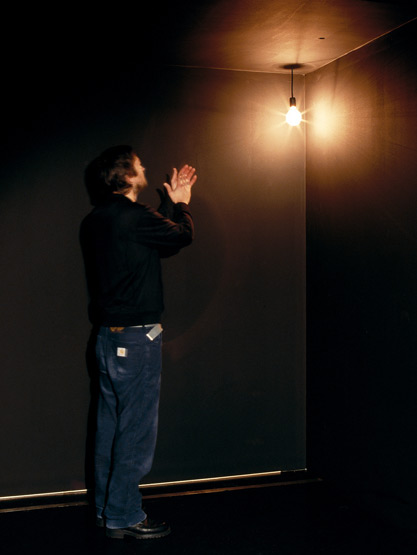
This piece Yoko Ono did with Fluxus relates very directly to mine because we use the same medium (video) to look at the striking and burning of a match. I would say that Yoko Ono's piece is far more minimalistic in its exploration while mine takes on a spatial component and the surrounding darkness, which I personally think is an important part of the human component tied to matches.


2. Yaacov Agam-Fiat Lux, 1967

Yaccov Agam likes to work with motion, sound and light. This piece is a lightbulb that turns on because of sound. I feel like the setting and singular light source relates to my piece. Matches produce a sound when lit and Agam is associating light with a sound as well as a space. I found this piece in the Light Art from Artificial Light book I checked out from the Dude.


3. Seth Riskin-Light Dances

Seth Riskin uses dance and light to show space in his works. His work is as much about the darkness as it is about the light source and human interaction. I am actually really excited that I discovered him because his artist statement (quoted below) reveals that we think in similar ways about light and space and movement.


"My first impulse as an artist was to become space. I wanted to bring viewers inside the movement experience, into contact with the numinous dimensions of space. Light allows me to realize this artistic vision.

In the Light Dance performances, light carries the subjective experience of movement beyond the limits of my body. Light Dance is a transposition of the “dance” from the body to the boundaries of the room. In silent, space-defining performances, light effects extend from my body. I “sculpt” space; precise body movements articulate fluid architectures of light, encompassing viewers with the “dance”.

Fundamental tenets of the Light Dance thesis include the concept that inner light and physical light are one, and that an experience of light can overcome the experience of body.

The silence of Light Dance I experience as wholeness. Inspired by a sense of the unlimited, I was led to light as a metaphor for deep knowing, dissolving borders between the body and space, the human spirit and material, the performer and viewer. I understand silence as I do darkness: not void, but whole, the fullest knowing of light, rather than its absence, that may be infinitely articulated and approached through art."


4. Plato's Allegory of the Cave

In his allegory Plato describes people chained to the wall in a cave. Behind them a fire burns and there are puppeteers making shadows. The people fear the shadows because they don't see what causes them. This is all they know of as reality.

I think this relates to my piece because the only light comes from the matches, which create shadows and reveal the world to the performer and audience at the same time. The performer and the camera become puppeteers, deciding what the viewer gets to see within the space at any given moment. Video uses a singular perspective, creating the only reality of my basement that the audience can know.


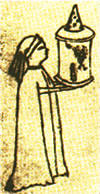
5. 15th Century Projector-Johannes de Fontana

The projector was initially invented in 1420 by Johannes de Fontana. He drew a picture (seen below) of a monk holding a lantern with a translucent window containing the image of a devil. Most of the initial projections were frightening and related to hell. I think the darkness and flickering shadows of candles and match light can take on that ambiance and they project shadows into a space, even if they are soft and out of focus (which is what Fontana's image would have looked like since his projector didn't have a lens).